'The very simplicity of the concept of "giving the public what it wants", and its too frequent use by those whose professional skill is cajolery of the simple-minded, should make us suspicious.' - Sir Hugh Greene, 1962
Showing posts with label bbc1. Show all posts
Thursday, 1 June 2017
David Edgar's Play for Today 'DESTINY' (1978) - essay for British Television Drama website
"An ideology red white and blue in tooth and claw"
I'm returning here to delightedly announce that I have a three-part epic essay about David Edgar's 1978 Play for Today, 'Destiny', currently being published on British Television Drama website. This is a significant play (currently viewable here) that dramatises the insurgent far-right and British national identity in the late 1970s. I have been researching this TV play for eight months and have included e-mail interviews with the writer and producer, as well as extensive use of the BBC WAC in Caversham (thanks to Matthew Chipping).
Thanks go to David Edgar and Margaret Matheson for their detailed e-mails with their memories of the play and conscientious answers to my questions. Thanks also to David Rolinson for his tireless work in editing this juggernaut of a piece (originally 20,000 plus words!), as well as Mark Sinker*, Justin Lewis**, Ian Greaves and John Williams who have assisted with queries and research.
Part 1 (David Edgar, the theatrical Destiny and British historical context) http://www.britishtelevisiondrama.org.uk/?p=7040
Part 2 (production of the TV play, its broadcast and its reception) http://www.britishtelevisiondrama.org.uk/?p=7043
Part 3 (analysis of the play and its afterlife and Edgar and Matheson's subsequent careers)
to be published 2 June 2017
*Who knows much more about English Baroque music than I.
**Who knows much more about UK chart history than I.
Tom May
Newcastle Upon Tyne
Tuesday, 26 May 2015
Top of the Pops (BBC-1, 01/05/1980)
(TX: BBC-4, 22/05/2015)
Imagine a universe where scantily-clad, objectified and anonymised women
strut about mechanistically to daintily piano-led jazz-funk music that now
evokes distant memories of late-1990s late-night music for Ceefax. Picture, if
you will, the Dionysian racket of Motörhead - introduced oddly as
'Leatherhead' by presenter Tommy Vance - followed immediately by the saccharine
tupperware pop of The Nolans.
This edition of TOTP is epitomised by openers New Musik, complete with
vaguely telefantasy-style watery set. If I haven't written about their From
A to B album before, then that's a massive oversight: it's a lovely fusion
of power-pop and synth-pop. The bassist appears thoroughly impassive, like a
Jeff Lynne statue in large dark glasses. The keyboardist plays the fool,
anticipating so much great Thomas Dolby geekery. Wimbledon-born Tony Mansfield
paces to the syncopated rhythm, both out-of-place and utterly comfortable on
this Top of the Pops. Mansfield went onto produce Cleaners from Venus,
responsible for that great unheard 1982 indie opus, Midnight Cleaners with
its impossibly lovely jangling volleys like 'Only a Shadow' and the best askew
pop essay in Englishness this side of XTC or Robyn Hitchcock.
That New Musik didn't mutate into fixtures of the pop scene in Britain
is testament to the usual British conservatism... That rare alignment of New
Musik, Buggles, Korgis and McCartney II is one of the most
delightful of 1980 English musical constellations.
Disco's there - how could it not be? Narada Michael Walden's 'I Shoulda
Loved You' shimmers gorgeously, with its soul-jazz horns and elemental groove.
Slightly less compelling is the reappearance of a latter-day Jimmy Ruffin, in a
Hawaiian shirt, belting out some mildly Barry White-esque soul ballad on a
balcony.
The 3-4 years late 'punk' brigade seem to fill one or two slots in every
1980 TOTP show, and The Chords are eminently forgettable in a sub-sub-The Jam
style. The distinct heavy metal presence is different to most 1970s charts, and
Tommy Vance is the apposite host, pronouncing 'lovin'' naturally without the
'g'. The genre has been on my mind, what with Marcello Carlin's sterling
writing on Iron Maiden and Def Leppard on Then Play Long. And,
also, Jeremy Deller's exhibition-come-treatise All That is Solid Melts
into Air, which I saw at the Laing art gallery in Newcastle, which used
Saxon's 'Wheels of Steel' as one of its video exhibits - the Sheffield band who
appear in this very TOTP. The conceptual exhibition also included popular
broadsides from the Victorian era, including one imagining a future utopia of
1973, as well as family trees of the Messrs Ryder, Holder and Ferry. Deller is
from the more analytical, socially engaged end of conceptual art; ironically,
given his Marshall Berman-citing title regarding modernism, his connections
became ever more concrete the more you moved around the exhibition and thought.
De-industrialisation was being experienced by young men in places like
Sheffield; not just Mick in Barry Hines and Ken Loach's 1981 film Looks
and Smiles, but Saxon and their 'Steel City' contemporaries. As Deller
argues, heavy metal is hewn from the memories of industry and its noises.
Then, there is the uncannily serene slice of jazz-funk I alluded to at
the start. Legs & Co. function as, well, legs and assorted objects to
accompany this almost chillingly calm piece of music: 'The Groove' by Rodney
Franklin. Sophisticated in a manner perhaps only achievable by instrumental
jazz-funk of this era. The fifteen year-old Gilles Peterson would surely have
enjoyed this, even if it is like the super-ego to the id of Incognito, Cymande
or Hi-Tension, a wonderful strain of British music he played much of on last
week's show.
During the 24/04/80 show, Steve Wright remarks: "Nice to see
something so unusual in the charts" - and he says that of Sky... The same
show included a one-two of The Cure's 'A Forest' and Elvis Costello's 'High
Fidelity'. There's more here; we don't just have an ode to UFOs with a
drone-like long introduction from supposedly 'safe' Hot Chocolate, but also
Kate Bush's 'Breathing', one of the most horrifying and gut wrenching of any
responses to the Second Cold War and the threat of nuclear
doomsday. It's from the same album as the crystalline John
Dowland-as-subtle-protest-song 'Army Dreamers'. If you aren't into Kate Bush by
this stage, then your taste is unfathomable to me! There's no more radical
place to start than Never for Ever and The Dreaming and
start all should.
The Beat - 'Mirror in the Bathroom': a window on a whole new world, to
paraphrase the great Dennis Potter. And Dexys Midnight Runners are at number
#1, with 'Geno'. It may not quite be my favourite of theirs: that is 'This Is
What She's Like' from five years hence. But it is another evolutionary step as
a number 1, following 'Going Underground' a month or two earlier.
To add to the unexpectedly purplish standard, we are thankfully not treated to
B.A. Robertson, a bane of this era and, not so much a poor man's Ian Dury, as a
'wacky' Bob Willis, Sky TV's inveterate misanthrope of a cricket commentator
(now sentenced, Rochester style, to inserts in the studio). This episode also
spares us the egregious Steve Wright, arms flung 'chummily' around invariably
female and voice-less audience members.
The audience lasses are permitted but a few words by Vance, and no, sadly,
they aren't colloquial or choice ones. Of course, when introducing the Cockney
Rejects, Wright emits an unspeakable 'amusing' blend of cockerney and his
mid-Atlantic RP: witness this and cringe.
Alas, this installment doesn't quite avoid Johnny Logan, as his 'What's
Another Year' plays over the yellow credits. Yes, blandness, or beigeness in
Kate Tempest's terms, always asserts itself in British culture, even amid the
more awakened musical culture of 1978-82. However, this programme is generally
of a different, stellar order to 1976 TOTP, which I wrote about over three
years ago here. We are seeing the infiltration of
subcultures and artistry of an altogether weirder and fresher hue, led by
talismans such as Kate and Kevin and overseen with wisdom and lightness of
touch by a 37-year-old Scouser named Paul. For the moment, commercial
compromise and cynicism seem to have been kept out, with the hapless Nolans the
ones marooned and marginalised.
Bizarrely, BBC-4 ordain to show an edited thirty minute version on
Thursday evenings, and then the full forty or so minuter later in the early
hours of Friday (here it is on iPlayer). Needless to say, the
edit is superfluous. As a friend has rightly argued, they should further
contextualise the show in its era by accompanying the TOTEP re-runs with
repeated dramas like Play for Today or documentaries like Russian
Language and People - which is at least partially available here,
happily.
Tommy Vance unfurls a one-liner, following New Musik's sprightly opening
number... "Just a minute I thought I was going to drown there,
but luckily I didn't." As Richard Hawley would appreciate, the ocean is
bountiful and strange enough to desire immersion.
Wednesday, 19 February 2014
Becoming a Legend: Blakes 7 - Series One
TX: BBC-1, 02/01/1978 - 27/03/1978
'Fascism threatens to become fashionable. I use the term loosely, but then people do. Call it totalitarianism, and in some guise or other it is a staple theme of teledrama: an all-purpose enemy, decked out with military precision, paramilitary uniform, uniformity of thought, one fatal flaw - and of course - our hero as dissident, battling against the odds to defeat it or perish.'
Welcome to the first of four joint-essays on each series of Blakes 7, inspired by Neil and Sue Perryman's undertaking to watch the lot and write about it at Adventures with the Wife and Blake. I am a donor for their Kickstarter project and have greatly enjoyed reading the blog, after watching the episodes. Sharing the viewing and, now, the writing with me is Ben Brown, with whom I have also been viewing much 'classic' Doctor Who and unusual cinema in recent times... You'll see Ben focusing on narrative, character and dialogue and myself exploting the show's cultural context, themes and myths.
Since being introduced to British sci-fi, I have been confronted with numerous robots, aliens, monsters, spacecraft, laser guns, eccentric - sometimes megalomaniacal - characters and a host of smug one-liners. Eventually my time came to be initiated into the cult following of the dark-ish, somewhat messed-up but often hilarious Blakes 7. This was series 1 and it was 1978. Echoes of Star Wars were still pulsing through the air. [Editor's note: In the Times' TV listings for episode 2, the link is made specific: 'To keep us going until we can actually get tickets for Star Wars, BBC has come up with a new series series Blakes Seven. Worth watching meanwhile.']
The man who brought the Daleks to millions now brought us seven rebellious crew members aboard an errant spaceship eventually to be called the Liberator. This man was Terry Nation and he would make sure he would have an iron grip on the first series by writing every single episode.
The story begins with the plight of our hero, Roj Blake. His memory has been damaged, as is revealed to him ten minutes into the first episode. He has but one disturbing and intense flashback to fall back on. Consequently, we are exposed time and again to Blake’s gaping mouth and the repetition of him being clubbed over the head by an agent of the Terran Federation. It turns out that this tyrannical, intergalactic power had been responsible for the murder of his family and the subsequent wiping of his memory. Upon reacquiring his memory of the atrocities committed by the Federation, he is sentenced to be deported to planet Cygnus Alpha along with other prisoners. A prominent dissident, the Feds have really gone to town on preventing Blake from becoming a martyr. When the charges are outlined to him, charges which basically amount to paedophilia, the apparently innocent Blake realises he has been fit-up and exclaims: “You’ve done a BRILLIANT JOB!” to the security cameras.
'Breakdown' opens with what appears to be Gan suffering from a stroke. Grasping his head, he slowly turns evil as the electronic limiter malfunctions.
Our Gan becomes a beast that needs neurosurgery to return to his non-killer self. A medical kit comprising tranquilizer pads - whatever the hell they are - is used to mollify the foaming Gan and he is restrained on a trolley with straps. A confused Blake is exasperated...
By 'Bounty' the crew feel compelled to help another prisoner of the federation, lepidopterist President Sarkoff. Playing his warbling record all day long, the man seems hell-bent on staying put, despite Blake’s appeal to him to leave with them. Eventually he relents when Blake smashes his precious record. A fair-to-middling episode, 'highlights' include futuristic Arab Sheik Tarvin groping Jenna but also his admission that he once sold his grandmother and another biting exchange between Villa and Avon:
In 'Deliverance' the crew land on planet Cephlon and again encounter primitives or “scavengers”, albeit not Decimers, but relatively human-looking ones. A frantic man named Ensor needs to get a box of power cells back to the planet on which his father lives, to save his life. At one point, Blake uses what sounds suspiciously like a sonic screwdriver to open the lid on it. First prize has to go to Ensor for the campest groan when he finally carks it.
Additionally, Avon encounters Meegat, who believes him to be a "Lord", which he revels in.
Blakes 7 is a strange beast and beast it most assuredly is. It lacks the possessive genitive and indeed an actual seven folk commanded by the freedom fighter or terrorist Roj Blake.
Nobody with any historical awareness would watch it expecting a 2014 level of special effects. Who cares about such concerns anyway? ‘Dated’ can be a positive label if it means that invention is to the fore in areas such as acting, direction and writing...
So, does Blakes 7 measure up?
Yes and no. Terry Nation is series one’s sole writer and it stands and falls according to this veteran telefantasy writer. Nation establishes a genuinely unpredictable, grim dystopia in the first episode. I haven’t seen any of his Survivors (1975-77) but assume it is similarly bleak. Opener ‘The Way Back’ is markedly more adult than his inane 1970s Doctor Who potboilers ‘Planet of the Daleks’ and ‘Death to the Daleks’. Indeed, it is more like Louis Marks’ ‘Day of the Daleks’ – with its guerrilla rebels – and LWT’s tremendous The Guardians (1971). He creates a dystopia with an absurdist show trial adjudicated by baubles in boxes, a summary massacre of unarmed civilians and accusations of child molestation. And this future also has an archivist jiving to his Walkman, a scene hinting at some of the ‘lighter’ moments to come in the series. Script editor Chris Boucher’s contribution is notable in adding a necessary acerbic humour.
Does Nation deliver in his thirteen episodes? Like Eve approaching verdant orchards and getting peckish, we invariably get the sort of Nation tropes that are guaranteed to be present whatever the programme he is writing for: caves, ice, genocide, radiation (sickness), carnivorous plants, cryogenic capsules, disease, genetic mutation and mutated viruses. (Thanks to West, Orton, Davidson et al.’s estimable tome Maximum Power! Miwk, 2012, for this inventory)
Certain episodes have potential – the Avon turns detective trope in ‘Mission to Destiny’, the simulacrum of the twentieth century exemplified by Sarkoff’s dwelling in ‘Bounty’. But these promises aren't consummated. The curious scene where Blake breaks Sarkoff’s antique opera record has no impact whatsoever, as the writing has not previously elicited concern about his supposed ‘plight’ or predicament. It is just T.P. McKenna being laid back and urbane listening to some tunes.
How was the show received critically?
In The Financial Times, Chris Dunkley saw it as looking cheap in comparison to Space: 1999, Star Wars and Alphaville and mentions tightening BBC budgets. While he describes it as more ‘derivative than hoped’ from Terry Nation who created Survivors and the Daleks, he can see the ‘human story’ becoming a ‘compelling habit’ over the series. There was a preoccupation on science and its fictions beyond Lucas land: Carl Sagan’s Planets lecture having shown on BBC-2 over Christmas 1977. More broadly, Dunkley identified British television’s over-focus on a perpetual British middle class in a state of ‘permanent hilarity’, with fictions set between the mid-nineteenth and early-twentieth centuries. He also slams the ‘xenophobic’ Mind Your Language and the unimaginative, ‘slavish’ aping of The Sweeney, not just by Target, but by a new series called The Professionals.
The Guardian's Peter Fiddick perceived that B7 did not trade in jokes', but then he was reviewing the show two episodes in, before its change in tone. It is described as 'a mix of olde worlde space jargon, ray guns, Western style goodies and baddies, and punch ups straight out of The Sweeney.' He locates it within the television tradition inspired by Orwell: Nineteen-Eighty Four, The Avengers, The Prisoner, The Guardians and 1990, describing 'The Enemy as Bureaucracy' and the prison ship with its 'ethics straight out of the warders' room at Belsen'. The Daily Mail - via critic Shaun Usher - gave a typically upbeat assessment of both Britain in 1978 and B7's dystopia, saying the show depicted 'the future as being much the same as the present, Lord help us, only worse.'

Ben Brown lives in Newcastle Upon Tyne. He works in the Medical Records department at the RVI in Newcastle and has studied Psychology at Master's level.
Tom May also lives in Newcastle Upon Tyne. He is a lecturer in English Language and Communication & Culture at a local Sixth Form College, having studied English and Film at universities southern and northern. He is working on a book about British culture and the cold war.
'Fascism threatens to become fashionable. I use the term loosely, but then people do. Call it totalitarianism, and in some guise or other it is a staple theme of teledrama: an all-purpose enemy, decked out with military precision, paramilitary uniform, uniformity of thought, one fatal flaw - and of course - our hero as dissident, battling against the odds to defeat it or perish.'
-- Peter Fiddick, 'Television: Blake's Seven', The Guardian, 10/01/1978, p.8
Welcome to the first of four joint-essays on each series of Blakes 7, inspired by Neil and Sue Perryman's undertaking to watch the lot and write about it at Adventures with the Wife and Blake. I am a donor for their Kickstarter project and have greatly enjoyed reading the blog, after watching the episodes. Sharing the viewing and, now, the writing with me is Ben Brown, with whom I have also been viewing much 'classic' Doctor Who and unusual cinema in recent times... You'll see Ben focusing on narrative, character and dialogue and myself exploting the show's cultural context, themes and myths.
BB:
Kerr Avon - Thorn in their Side?
Since being introduced to British sci-fi, I have been confronted with numerous robots, aliens, monsters, spacecraft, laser guns, eccentric - sometimes megalomaniacal - characters and a host of smug one-liners. Eventually my time came to be initiated into the cult following of the dark-ish, somewhat messed-up but often hilarious Blakes 7. This was series 1 and it was 1978. Echoes of Star Wars were still pulsing through the air. [Editor's note: In the Times' TV listings for episode 2, the link is made specific: 'To keep us going until we can actually get tickets for Star Wars, BBC has come up with a new series series Blakes Seven. Worth watching meanwhile.']
The man who brought the Daleks to millions now brought us seven rebellious crew members aboard an errant spaceship eventually to be called the Liberator. This man was Terry Nation and he would make sure he would have an iron grip on the first series by writing every single episode.
The story begins with the plight of our hero, Roj Blake. His memory has been damaged, as is revealed to him ten minutes into the first episode. He has but one disturbing and intense flashback to fall back on. Consequently, we are exposed time and again to Blake’s gaping mouth and the repetition of him being clubbed over the head by an agent of the Terran Federation. It turns out that this tyrannical, intergalactic power had been responsible for the murder of his family and the subsequent wiping of his memory. Upon reacquiring his memory of the atrocities committed by the Federation, he is sentenced to be deported to planet Cygnus Alpha along with other prisoners. A prominent dissident, the Feds have really gone to town on preventing Blake from becoming a martyr. When the charges are outlined to him, charges which basically amount to paedophilia, the apparently innocent Blake realises he has been fit-up and exclaims: “You’ve done a BRILLIANT JOB!” to the security cameras.
![]() |
| "You've done a BRILLIANT JOB!" |
Before mnemonic revival kicks in, we have to watch as Blake is told that he is guilty, and while pacing his cell like a caged animal, swears that he “is not insane!” and bellows out that he can’t “remembah… remembah… remembah… remembah…!” – a roar that still echoes in my ears to this day. Blake eventually escapes the Federation aboard the spaceship renamed The Liberator, and gradually acquires six fellow convicts to accompany him along the way:
Kerr Avon is acerbic, cool and ultra-intelligent, don’t you know? When the need arises, he is quite able to conduct himself as the ship’s resident sleuth. A Cluedo-like scenario arises in 'Mission to Destiny', where the only major difference to the usual set-up is the substitute of a manor house for a spaceship control room. It all begins when Mr Hopwood from Grange Hill keels over while trying to man the controls of a spaceship. This, of course, warrants the use of a screaming banshee named Sara upon discovery of the corpse. Eventually the members of B7 find that murder is apparent on this spaceship and Avon takes it upon himself to fit the pieces of the puzzle together.
Avon completes his moment to shine in this episode by eventually socking Sara in the mouth when he discovers she is actually behind the murders!
Cally is an alien guerrilla fighter from planet Auron. Initially and understandably hostile, she is confronted by Vila who reassures her.
By the time of 'Time Squad', our crew is virtually fully formed to the delight of an enthusiastic Gan. Avon cannot resist slipping in another caustic remark:
Every sci-fi hero needs their nemesis and Blake’s turns up in the form of eye-patch wearing Commander Travis, looking imposing with his hands on his hips. He complains to his superior Servalan that Blake is becoming a legend.
Kerr Avon is acerbic, cool and ultra-intelligent, don’t you know? When the need arises, he is quite able to conduct himself as the ship’s resident sleuth. A Cluedo-like scenario arises in 'Mission to Destiny', where the only major difference to the usual set-up is the substitute of a manor house for a spaceship control room. It all begins when Mr Hopwood from Grange Hill keels over while trying to man the controls of a spaceship. This, of course, warrants the use of a screaming banshee named Sara upon discovery of the corpse. Eventually the members of B7 find that murder is apparent on this spaceship and Avon takes it upon himself to fit the pieces of the puzzle together.
AVON: … The plan had gone to pieces. The best the killer could hope for was to delay a full inquiry for as long as possible. As a matter of fact, I think that was a waste of effort. I know - we all know, that one of you is the murderer. But proving which one... Unless, of course, as seems quite likely, someone other than the murderer already knows...
![]() |
| A whodunnit in corridor land! |
Avon completes his moment to shine in this episode by eventually socking Sara in the mouth when he discovers she is actually behind the murders!
AVON: You better get her out of here. I really rather enjoyed that!Olag Gan is the ship’s strong-man, and although unable to kill, due to the implantation of electronic limiter into his neck, he is quite capable of threatening to tear off some one’s arms and legs if he gets rubbed up the wrong way.
GAN: Couldn't stop the... Couldn't stop the... implant [grunt!]Vila Restal is a lock-picker and coward and can be relied upon to deliver the odd snappy one-liner, usually to himself, except when drawn into a confrontation with… you guessed it… Avon, over access through a door.
VILA: Listen, Fingers, computers are yours, doors are mine, right?Jenna Stannis, initially the only female aboard the Liberator, is the sexy blonde action-woman who is more than capable of carefully choreographed martial arts. She seems to like Blake and show concern for him when he returns to the ship unscathed from some action on Cygnus Alpha.
JENNA: I was so worried!
BLAKE: I had a few sweaty moments myself!
Cally is an alien guerrilla fighter from planet Auron. Initially and understandably hostile, she is confronted by Vila who reassures her.
VILA: No need for belligerence, pretty lady. I'm harmless!Zen, the Liberator’s computer, informs the rest of the crew of approaching planets, danger and encroaching ships in a bored voice which was probably meant to sound inhumanly electronic. When he asks Blake to be more precise about a question surrounding the whereabouts of his crew, the unfortunate Zen is on the receiving end of an impatient Blake who barks: "The others! My crew! Where are they!?"
By the time of 'Time Squad', our crew is virtually fully formed to the delight of an enthusiastic Gan. Avon cannot resist slipping in another caustic remark:
GAN: I think we make a great team
AVON: Well, hooray for us!It soon becomes apparent that the other crew members can only take so much of Avon’s saturnine comments. Gan soon gets his revenge on Avon when Avon knocks another one of Blake’s ideas:
GAN: For a clever man you're not very bright!Presumably Gan replayed that moment over again and again to much satisfaction while lying on his bunk. Later on Blake finally snaps like a father to a misbehaving child:
GAN: We can talk and travel. We’re safer on the move.The adventures that follow are sometimes ridiculous, sometimes entertaining and sometimes quite boring. Our crew land in the superfluous episode 'The Web', and we are presented with foetus-in-a-jar thing, Saymon, who chants to us in a spooky voice:
AVON: Another one who’s prepared to let Blake do his thinking for him.
BLAKE: Enough, Avon!
SAYMON: They. Must. Come. To. Us...!Highlights of this episode include Cally turning evil and lamping Villa when he innocuously asks her what she thinks of his outfit. Green alien blobs, the tearful and vengeful Decimers are quite amusing as they hysterically dash about the place, clamouring at glass doors and hammering on them for dear life. They also count football as one of their native sports, traditionally played with a withered head. Jenna pays tribute to The Exorcist (1973) by becoming possessed, unfortunately without the projectile vomiting. Avon also manages to slip in some bile, in revenge to Gan’s earlier affront to his intelligence.
AVON: [The automatic repair system] It's slow - you should appreciate that problem.Otherwise, the episode is needless and ludicrous with much head-fuddling jargon.
Every sci-fi hero needs their nemesis and Blake’s turns up in the form of eye-patch wearing Commander Travis, looking imposing with his hands on his hips. He complains to his superior Servalan that Blake is becoming a legend.
SERVALAN: Blake is just a man!The pair extensively lock heads in 'Duel', a great episode which includes Blake in a noticeably lighter mood for the first time. This lasts until The Liberator is attacked. A hilarious scene of slowed-down speech and strung-out psychedelia ensues to evoke a feeling of calamity. The episode also has Blake’s face turning intermittently blue at one point! A real scene-stealer here is Patsy Smart as Giroc, the old crone who relishes the war between Blake and Travis. About Travis, she cackles:
GIROC: Not only is he primitive, he’s pompous as well!
'Breakdown' opens with what appears to be Gan suffering from a stroke. Grasping his head, he slowly turns evil as the electronic limiter malfunctions.
Our Gan becomes a beast that needs neurosurgery to return to his non-killer self. A medical kit comprising tranquilizer pads - whatever the hell they are - is used to mollify the foaming Gan and he is restrained on a trolley with straps. A confused Blake is exasperated...
BLAKE: Because I don't know what to do about it! And if it is the limiter, I don't know how we can help him. Unless neurosurgery is one of your particular talents.Vila warns that, unless something is done, the unfortunate Gan may end up like a vegetable – that is, more vegetable-like than normal! The stress begins to get to the crew members and Avon snipes at Blake again:
AVON: Unfortunately, no.
AVON: Staying with you requires a degree of stupidity I no longer feel capable of!Fortunately the day is saved by the efforts of the brain surgeon, Professor Kayn and his assistant, Renor, who seems more horny than focused on the job in hand:
RENOR: Hello! This place is full of pretty girls.Ultimately, Gan’s limiter is fixed and all returns to “normal”. Blake becomes uncharacteristically jubilant and surrounded by his crew members, says to Gan:
BLAKE: Oh and... by the way, welcome back!This generates such uproarious laughter that it was at this point that I questioned the state of Blake’s mental health. I noticed his mood is “all or nothing” – he’s either seriously intense or in fits of laughter. Bipolar? PTSD? The stress of his family being murdered, accusations of child molestation and running a spaceship has clearly taken its toll on him by this point.
By 'Bounty' the crew feel compelled to help another prisoner of the federation, lepidopterist President Sarkoff. Playing his warbling record all day long, the man seems hell-bent on staying put, despite Blake’s appeal to him to leave with them. Eventually he relents when Blake smashes his precious record. A fair-to-middling episode, 'highlights' include futuristic Arab Sheik Tarvin groping Jenna but also his admission that he once sold his grandmother and another biting exchange between Villa and Avon:
VILLA: I'm entitled to my opinion.
AVON: It is your assumption that we're entitled to it too that is irritating.
In 'Deliverance' the crew land on planet Cephlon and again encounter primitives or “scavengers”, albeit not Decimers, but relatively human-looking ones. A frantic man named Ensor needs to get a box of power cells back to the planet on which his father lives, to save his life. At one point, Blake uses what sounds suspiciously like a sonic screwdriver to open the lid on it. First prize has to go to Ensor for the campest groan when he finally carks it.
Additionally, Avon encounters Meegat, who believes him to be a "Lord", which he revels in.
Vila thinks the “poor woman” must be "insane". Vila is somewhat put out that it is not him.
The series comes to an end when the crew acquire another computer – a supercomputer called ORAC, worth some 100 million credits. It has “all the knowledge of all the worlds”. It shows its sarcastic side when Vila speaks:
AVON: You are hardly the stuff that Gods are made of.The last episode contains the only recap in the series – a bloated one that smacks of padding. We meet daddy Ensor, the Prof with his mechanical ticker, who insults the helpful crew by calling them “morons”. He eventually dies anyway.
The series comes to an end when the crew acquire another computer – a supercomputer called ORAC, worth some 100 million credits. It has “all the knowledge of all the worlds”. It shows its sarcastic side when Vila speaks:
VILA: I think I've heard enough. I don't like him. Orac, be a good junk heap - shut up.The scene is thus set for series 2.
CALLY: I agree with Vila.
ORAC: Define the words 'Shut up.'
TM:
‘Without computers we’re dead’
Blakes 7 is a strange beast and beast it most assuredly is. It lacks the possessive genitive and indeed an actual seven folk commanded by the freedom fighter or terrorist Roj Blake.
Nobody with any historical awareness would watch it expecting a 2014 level of special effects. Who cares about such concerns anyway? ‘Dated’ can be a positive label if it means that invention is to the fore in areas such as acting, direction and writing...
So, does Blakes 7 measure up?
Yes and no. Terry Nation is series one’s sole writer and it stands and falls according to this veteran telefantasy writer. Nation establishes a genuinely unpredictable, grim dystopia in the first episode. I haven’t seen any of his Survivors (1975-77) but assume it is similarly bleak. Opener ‘The Way Back’ is markedly more adult than his inane 1970s Doctor Who potboilers ‘Planet of the Daleks’ and ‘Death to the Daleks’. Indeed, it is more like Louis Marks’ ‘Day of the Daleks’ – with its guerrilla rebels – and LWT’s tremendous The Guardians (1971). He creates a dystopia with an absurdist show trial adjudicated by baubles in boxes, a summary massacre of unarmed civilians and accusations of child molestation. And this future also has an archivist jiving to his Walkman, a scene hinting at some of the ‘lighter’ moments to come in the series. Script editor Chris Boucher’s contribution is notable in adding a necessary acerbic humour.
Does Nation deliver in his thirteen episodes? Like Eve approaching verdant orchards and getting peckish, we invariably get the sort of Nation tropes that are guaranteed to be present whatever the programme he is writing for: caves, ice, genocide, radiation (sickness), carnivorous plants, cryogenic capsules, disease, genetic mutation and mutated viruses. (Thanks to West, Orton, Davidson et al.’s estimable tome Maximum Power! Miwk, 2012, for this inventory)
On 19th February 1978, Michael Palin recorded in his diary attending a BBC Enterprises banquet at the Old Ship Hotel where the Corporation was promoting its current roster of programmes. He mentions chatting with Terry Nation; Nation congratulates Palin on 'The Testing of Eric Olthwhaite', broadcast as part of the sublime Ripping Yarns exactly five years to the day before my birth. Palin mentions returning the compliment regarding Nation's new series, Blakes 7. He surely can't have caught 'The Web'!
Weaker episodes: well, there isn’t a dearth. Unlike my comrade in this project, I found ‘Time Squad’ tedious and inconsequential, with the cryogenically frozen astronauts a cringe-worthy ‘threat’. The aforementioned ‘The Web’ is just risible, making Doctor Who’s ‘The Mutants’ seem like Satyajit Ray’s Distant Thunder (1973). I may have been ironically entertained by it during the 2000 BBC-2 repeats, but this time I was struck by the preposterous monotony of solemn proto-New Romantics wandering around a meagre holiday camp, which is being pelted by tot-sized ‘savages’: the Decimas. On top of all this, there’s a foetal monkey thing in a tank. This is assailed at the end by the Decimas running amok – in scenes that rival any in television for their rowdy absurdity.
Certain episodes have potential – the Avon turns detective trope in ‘Mission to Destiny’, the simulacrum of the twentieth century exemplified by Sarkoff’s dwelling in ‘Bounty’. But these promises aren't consummated. The curious scene where Blake breaks Sarkoff’s antique opera record has no impact whatsoever, as the writing has not previously elicited concern about his supposed ‘plight’ or predicament. It is just T.P. McKenna being laid back and urbane listening to some tunes.
For me, the strongest episodes are ‘Duel’ and ‘Orac’. The former is mainly down to Douglas Camfield’s direction, which gives it a psychedelic and energetic gusto. Strangely, Cornell, Day and Topping describe ‘Duel’ as doing ‘little to inspire confidence’, mentioning its similarity to a Star Trek episode. (The Guinness Book of Classic British TV, 1993, p.299) However, its tone and weirdness distinguish it; Camfield treats us to slowed-down voices, frayed 1970s colours and flashing lights: the non-naturalism and ripe acting make it the highlight of series one.
‘Orac’ possesses refined plotting and urgency, ably bringing several threads together to round off the series. It features a range of settings – a beach, caves, a greenhouse-type science lab – which benefit the narrative.
It also subtly associates with JG Ballard; like in his evocative novel The Drowned World (1962), cities have been overtaken by environmental catastrophe and reptilian life-forms have come to the fore – they are mercifully used sparingly, kept in the shadows. The imagination is enticed not satiated.
Throughout the series, the music does get a little wearing; predictable Dudley Simpson soundtrack follows… predictable Dudley Simpson soundtrack. Most of his music is competent but uninspiring and becomes the archetypal aural ‘wallpaper’ that limits the drama. ‘The Way Back’ is intensely more effective, due to the sparring use of its more ambient, electronic soundtrack. ‘Duel’ is also made more unusual and engaging by its drifting, distant Popol Vuh-esque undertow of synths.
The acting tends to salvage things, although it is by no means consistent across the series. There are some utter stalwarts – Julian Glover imbues the preposterous melodrama ‘Breakdown’ with gravitas when he shows up thirty minutes in as surgeon Kayn. Brian Blessed enlivens the middling ‘Cygnus Alpha’; a year or so on from his subtle and spellbinding turn as Augustus in I, Claudius, he is in the default deafening mode exhibited in two guest appearances in Space: 1999 and, frankly, the rest of his post-Vargas career. This sort of performance is necessary to enliven a plodding episode, and his death scene is wonderfully ludicrous, to the point of surrealism.
![]() |
| "I... RULED!?!?" |
Best of all is Derek Farr in the season finale. The veteran TV and film actor plays the cantankerous Professor Ensor with dynamism and heart. Farr’s CV included films like Town on Trial (1957) and The Dam Busters (1955) and TV programmes as various as Play for Today, Days of Hope, Bergerac, Star Maidens, The Avengers and Dixon of Dock Green. I have seen some of Nightingale’s Boys, Granada’s thoughtful 1975 series reflecting on grammar schools and idealism – Farr plays the old schoolmaster, Bill Nightingale. At the end of ‘Orac’, he voices that titular character, an impudent and imperious piece of hardware, which will hopefully mean Farr plays a significant part in series two.
The regular cast do their best with often variable material. None of them were household names and they do not appear in Jonathan Meades’ mordant book This Is Their Life, ‘a fascinating look’ into the hobbies, habits and home-life of ‘your favourite T.V. personalities’. By 1979, Darrow, Thomas et al had clearly not joined the favoured roster that included Dave Allen, Joan Bakewell and Derek Nimmo.
![]() |
| It's better than Shakespeare, this! You even get to wrestle monks. |
The RSC trained Gareth Thomas came to B7 soon after an authoritative performance in HTV West’s eerie and uncanny Children of the Stones (1977) and, as Cornell, Day and Topping argue, he lends a solid, down to earth quality to Blake, grounding his quest. He can be liked or disliked depending on one’s feelings about Avon and Blake's particular tactics – and he forms, in Servalan's words, a plausible "rallying point for malcontents". Sally Knyvette retains a certain dignity despite the accumulation of inapt implied rape threats that Jenna is confronted with. Michael Keating is underused as Vila, yet deftly delivers lines which serve his function as ‘comic foil’. Jan Chappell is ill-served as Cally, contributing little to the narrative other than to be patronised.
David Jackson drew the shortest straw as Gan, the hulking great barbarian who cannot kill. He can only overact, as in ‘Breakdown’ - his centrepiece, where Gan is given next to no lines but plenty of chance to grip his bonce and out-gurn Jon Pertwee. Or, fail to make crass Neanderthal lines sound sincere, as in ‘Time Squad’: “He killed my woman…”
That same story has Gan’s chirpy “I think we make a great team!” answered by Avon in utterly languid, sardonic tones: “Well hooray for us.” Paul Darrow’s Avon is by far the strongest character in series one. Terse, sarcastic, deadpan: as the episodes accumulate, his icy asides grow in number and quality. Darrow facilitates what this show fundamentally is all about: a fractious group comprised of idealists, ne’er do wells and selfish malcontents quite frankly not getting on. American television often thrives in portraying harmonious groups; B7’s British cynicism and awkwardness is often vastly entertaining.
Jenna’s self-description as a ‘free trader’ gives food for thought, considering B7 accompanied Thatcher’s rise. Avon is both self-interested individual and detached computer nerd, suggesting he is a man of the future - in several senses. As a supposed smuggler Jenna seems rather easily won over to Blake’s idealistic cause. ‘Bounty’’s villain Tarvin (Marc Zuber) represents the mercantile tendency; he is given one great line, confirming he sold his own grandmother to stop being sold himself. But, fundamentally, Tarvin is a stereotyped Arab rogue, with little sense that he or his values matter in the show’s world. The preceding ‘Breakdown’ has Glover’s surgeon make several irate attacks on bureaucracy through its ineffectual embodiment in Farron: “You bureaucratic fool” “You gutless nothing!” Characters of such poise as Kayn and Avon are shown to be superior to the dull systemic thinking of the Federation, which may represent a future socialist or fascist Britain, depending on your viewpoint. From Powell and Pressburger’s A Matter of Life and Death onwards, British culture took a critical stance towards hidebound thinkers like Farron, hiding behind the directives of state planning: “You pathetic feeble minded little bureaucrat!”
There is a strangely telling moment at the end of ‘Breakdown’; the independent space station has been destroyed, killing hundreds of people, including Kayn and Farron. This was a preferred ‘bolthole’ for Avon to escape to and make some money. After a brief moment’s solemnity speaking to Avon, Blake goes over to Jenna and Gan and they are all quickly laughing jovially about Gan’s restoration to health. Avon’s reaction is not shown.
Series one went out on Mondays at 7.15pm on BBC-1*; it averaged an impressive 9.22 million viewers – starting out with 7.4 million and closing with the 10.6 million who watched ‘Orac’.
That same story has Gan’s chirpy “I think we make a great team!” answered by Avon in utterly languid, sardonic tones: “Well hooray for us.” Paul Darrow’s Avon is by far the strongest character in series one. Terse, sarcastic, deadpan: as the episodes accumulate, his icy asides grow in number and quality. Darrow facilitates what this show fundamentally is all about: a fractious group comprised of idealists, ne’er do wells and selfish malcontents quite frankly not getting on. American television often thrives in portraying harmonious groups; B7’s British cynicism and awkwardness is often vastly entertaining.
“We could be up to our armpits in homicidal maniacs within the hour!” (1.4)Part of the problem with the narrative of this first series is Travis: he’s a monotone baddie, clad in black with a ‘sci-fi’ eye patch. Stephen Grief infuses Travis with less charm and genuine threat than Roger Delgado did with his similarly omnipresent Master in Pertwee era Doctor Who. In multiple appearances, he speaks about how much he wants to kill Blake but invariably fails to do so. With each reappearance, his general aura of haplessness increases. Servalan is relatively insignificant in this series – I assume she’ll get more to do as B7 develops. Too many episodes revolve around Travis’ ill-starred pursuit of Blake: for instance, ‘Project Avalon’. Unlike Cornell, Day and Topping, I didn’t find this ‘snowbound resistance melodrama’ remotely interesting, merely leaden. We could also have done with a deeper portrayal of the Federation, through a greater number of characters.
There is a strangely telling moment at the end of ‘Breakdown’; the independent space station has been destroyed, killing hundreds of people, including Kayn and Farron. This was a preferred ‘bolthole’ for Avon to escape to and make some money. After a brief moment’s solemnity speaking to Avon, Blake goes over to Jenna and Gan and they are all quickly laughing jovially about Gan’s restoration to health. Avon’s reaction is not shown.
Series one went out on Mondays at 7.15pm on BBC-1*; it averaged an impressive 9.22 million viewers – starting out with 7.4 million and closing with the 10.6 million who watched ‘Orac’.
*Barring 'The Way Back', that slice of brutality which went out in the Doctor Who time-slot of 6pm. In a DVD commentary to 'Space Fall', producer David Maloney mentions many in the audience coming to it after being DW viewers from a young age. This scheduling clearly has much to answer for in how it shaped today's British forty-somethings!
How was the show received critically?
In The Financial Times, Chris Dunkley saw it as looking cheap in comparison to Space: 1999, Star Wars and Alphaville and mentions tightening BBC budgets. While he describes it as more ‘derivative than hoped’ from Terry Nation who created Survivors and the Daleks, he can see the ‘human story’ becoming a ‘compelling habit’ over the series. There was a preoccupation on science and its fictions beyond Lucas land: Carl Sagan’s Planets lecture having shown on BBC-2 over Christmas 1977. More broadly, Dunkley identified British television’s over-focus on a perpetual British middle class in a state of ‘permanent hilarity’, with fictions set between the mid-nineteenth and early-twentieth centuries. He also slams the ‘xenophobic’ Mind Your Language and the unimaginative, ‘slavish’ aping of The Sweeney, not just by Target, but by a new series called The Professionals.
The Guardian's Peter Fiddick perceived that B7 did not trade in jokes', but then he was reviewing the show two episodes in, before its change in tone. It is described as 'a mix of olde worlde space jargon, ray guns, Western style goodies and baddies, and punch ups straight out of The Sweeney.' He locates it within the television tradition inspired by Orwell: Nineteen-Eighty Four, The Avengers, The Prisoner, The Guardians and 1990, describing 'The Enemy as Bureaucracy' and the prison ship with its 'ethics straight out of the warders' room at Belsen'. The Daily Mail - via critic Shaun Usher - gave a typically upbeat assessment of both Britain in 1978 and B7's dystopia, saying the show depicted 'the future as being much the same as the present, Lord help us, only worse.'
In The Times, Stanley Reynolds reviewed 'Time Squad'; he praises B7's seriousness: its being 'straight, with real villains' and also its episodes being self-contained yet adding to a 'saga'. He enjoys the script with its 'terse commands' and its sense of action: Jenna 'fighting off the Findus fiends'. He mentions Cally as 'the latest addition to Blake's outer-space merry men' and the prospect of her spelling 'love trouble for blonde Jenna', of a sort not faced by Maid Marian in Robin Hood: incidentally, a powerful British myth that Blakes 7 taps into.
Despite such motifs as air ducts, corridors, gullible guards, sundry pygmies, nomadic scavengers and medieval types; despite excess sexism on several fronts and perpetual lines like “Do you read me…?” B7 series one seems worthwhile. There are just enough well-crafted episodes and acidic one-liners for it to achieve a distinctively down at heel British charm.
Here's how we rated each episode, plus attribution for writing and direction - the former shows impressive variety! Also recorded are dates of transmission and the viewing figures:

Ben Brown lives in Newcastle Upon Tyne. He works in the Medical Records department at the RVI in Newcastle and has studied Psychology at Master's level.
Tom May also lives in Newcastle Upon Tyne. He is a lecturer in English Language and Communication & Culture at a local Sixth Form College, having studied English and Film at universities southern and northern. He is working on a book about British culture and the cold war.
Labels:
1978,
bbc1,
Blakes 7,
Brian Blessed,
David Maloney,
Derek Farr,
Douglas Camfield,
Dudley Simpson,
dystopia,
free trade,
Gareth Thomas,
Julian Glover,
Paul Darrow,
Sally Knyvette,
state planning,
Terry Nation
Monday, 31 December 2012
Old Woman Swears: "Mrs Brown's Boys"
'Mammy Christmas' (part 1 of 2)
TX: 29/12/2012, BBC 1'The number of those who undergo the fatigue of judging for themselves is very small indeed'
- Sheridan, The Critic (1781)
After too long, us Messrs Lichfield and May return to some TV blogging, whilst simultaneously watching the goggle box. One is not entitled to an opinion on a book, a film or TV series if you've not read or seen it; thus, we trust you will appreciate an undertaking of truly fatiguing proportions.
Tom: Here we go...
Tom: A back-to-back two-parter? Why?
David: I even hate the title sequence.

Tom: That's an inept title sequence, aye.
Tom: [recalling the announcer's words about not having to listen to Slade any longer] Better hearing from Slade than this.
David: This is some cringe-worthy shit.
Tom: There’s laughter…
David: Tackiest sitcom ever.
Tom: 'Mammy Christmas'. Up a tree, tee-hee.

David: Old woman swears. Ho ho ho.
Tom: “Wek up yerbastud!”
Tom: Seemingly, speaking in an Irish accent is in itself a guarantee of 'humour'.
Tom: “Bono, my grandson”. Ha, very amusing.
David: I can guarantee I won't be laughing once.
Tom: On the “feck”-count we so far haven't any score. I reckon that'll change.
David: Three “bastard”s though.
David: No camp stereotypes here…

David: He's a hairdresser.
David: [following inordinate studio audience snickering] These jokes don't merit that level of uncontrollable laughter.

Tom: Winnie... She embodies that certain sort of irritating, 1970s/80s sitcom busybody with infuriatingly perky body language shit.
David: Even the transitions between scenes are cheap.

Tom: Hilarity ensues here.
David: Production values of a scotch egg.
Tom: Some idiot dressed as a chicken.
Tom: Ah, there had to be a priest here…
Tom: And now there’s a second one. Oddly, they seem to like rubbing in the fact that this isn't Father Ted.
David: Oh, looks like it’s Shelley-off-Corrie's mum.
Tom: The studio audience seem to react to the line “Who the fuck are you?” with utter, unabashed hilarity.
David: I'm sure we've had no “fecks” but two “fuck”s.
David: Pointlessly crude.
David: Can't we write some toss like this and set ourselves up financially for life? I thought we were past one-dimensional stereotypes in comedy?
David: Five “fucks”?
Tom: Six.
Tom: This is as irritating as anything...
David: The Scouting for Girls of sitcoms.

Tom: Now this is comedy... for people who are either without a brain. I say that in sorrow rather than anger - the level of this is depressing.
David: Or the Mumford and Sons of Irish comedy.
Tom: [following some inexplicably inane moment] Did we need that?
David: At least Last of the Summer Wine was charmingly unfunny.
Tom: [Sighs] 'Funny' religion stuff and Richard Branson 'gag'.
David: It's offensive in a completely different manner than it seems was intended.
Tom: “Winnie, it was a joke!!” If these are jokes than Silvio Berlusconi is an honourable man.
Tom: Forced laughter there from the characters themselves.

David: It's not even close to guilty pleasure status.
Tom: No pleasure in this. “Fuck no”, to quote Mrs Brown herself there.
David: Lazy, clichéd, embarrassing, boring, outdated, nonsensical, unimaginative, cheap, brainless toss.
Tom: He-he, cream over his chin forms a Santa Claus-esque beard; that's fecking inspired!
David: A cunt dressed as a cabbage.

Hey, characterization! No wait, I don't recall a single thing to like about these 'people'...
Tom: “The poor little mites”.
Tom: They think that that’s funny, seemingly – the use of the word “Panini”.
Tom: No character comedy here, other than in the broadest sense...
David: It's outrageous that this sort of shit's getting commissioned in 2012. It's like the last thirty years of comedy never happened: the only concession to alternative comedy being over-use of the word “fuck”.
Tom: Such gurning fool faces.
Tom: “FECK” #1!
Tom: “The bucking biscuits” – Stanley Unwin-esque quality wordplay there.
David: Gives the cheesiest of 1970s sitcoms a bad name. At least they had to be relatively clever about sneaking sexual references in.
Tom: And the two old biddies are under the table again.

Tom: And, surprisingly enough, there is some headbanging.
David: Has anyone fallen over yet?
Tom: This is epically tiresome.
Tom: Ah, “feck” again there.

Tom: And Fiona Phillips as the daughter.

David: It's an old woman swearing. It's an old woman swearing. IT'S AN OLD WOMAN SWEARING. That's the entire premise of the show.
Tom: Fiona subject to yet another cream drenching.
Tom: “Bono”. FUCK OFF.
David: If I was Irish I'd be personally offended by this dreck.
Tom: 'Awww...' There are sighs from the studio audience.
Tom: There's a tacked-on left-turn into sentimentality that just doesn't wash...
David: Utterly charmless.
David: Are you sure this isn't an hour?

Tom: Fairy tales and the kids... They think they can imbue this with charm at the end? After the sheer grim gormlessness of the rest of it?
Tom: Pan-pipe shite on the soundtrack. Sir Cliff Richard would be proud.
Tom: Mrs B Looks to the camera – and, yep, US, THE AUDIENCE BACK HOME.
Tom: “Goodnight Bono”…
David: Why should sitcoms for the masses have to be this toss? It's no Only Fools and Horses!

Tom: That was teeth-grinding, unremitting, desultory codswallop of the basest type.
David: That was one of the unfunniest, steaming piles of excrement I've ever sat through.
Tom: Then featuring an 'amusing' little cartoon Agnes on the end titles.
David: NO REDEEMING FEATURES.
Tom: From a country that produced W.B. Yeats and Father Ted, that was unforgivable. It made So Haunt Me look like Fawlty Towers.
David: It's bad enough living through this political and social horror without all the culture going to shit too.
Tom: What is the BBC thinking? Putting this in prime-time...
David: Was massive in Ireland for various series first, worryingly.
David: Why would a country enjoy being stereotyped like that?!
Tom: The only benefit is that we're allowed not to watch the second episode...
David: I literally would pay not to.
Tom: I think an hour of that would turn Kriss Akabusi into a subdued depressive.
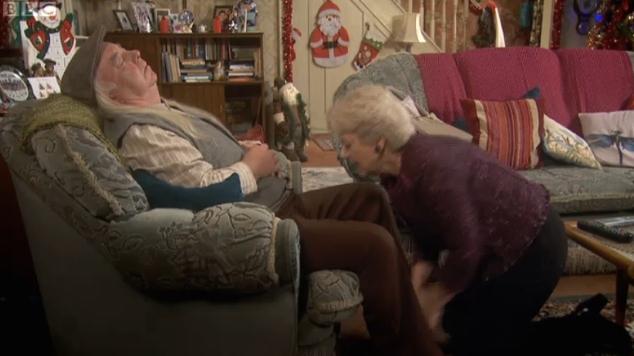
ADDENDUM. While sourcing the screen-shots above, I struggled to access the BBC iPlayer broadcast due to some automatically imposed 'Parential Guidance' control. A Quality Control quarantine might be more advisable.
Subscribe to:
Posts (Atom)